Which beach do you actually get when you buy in Seaside?
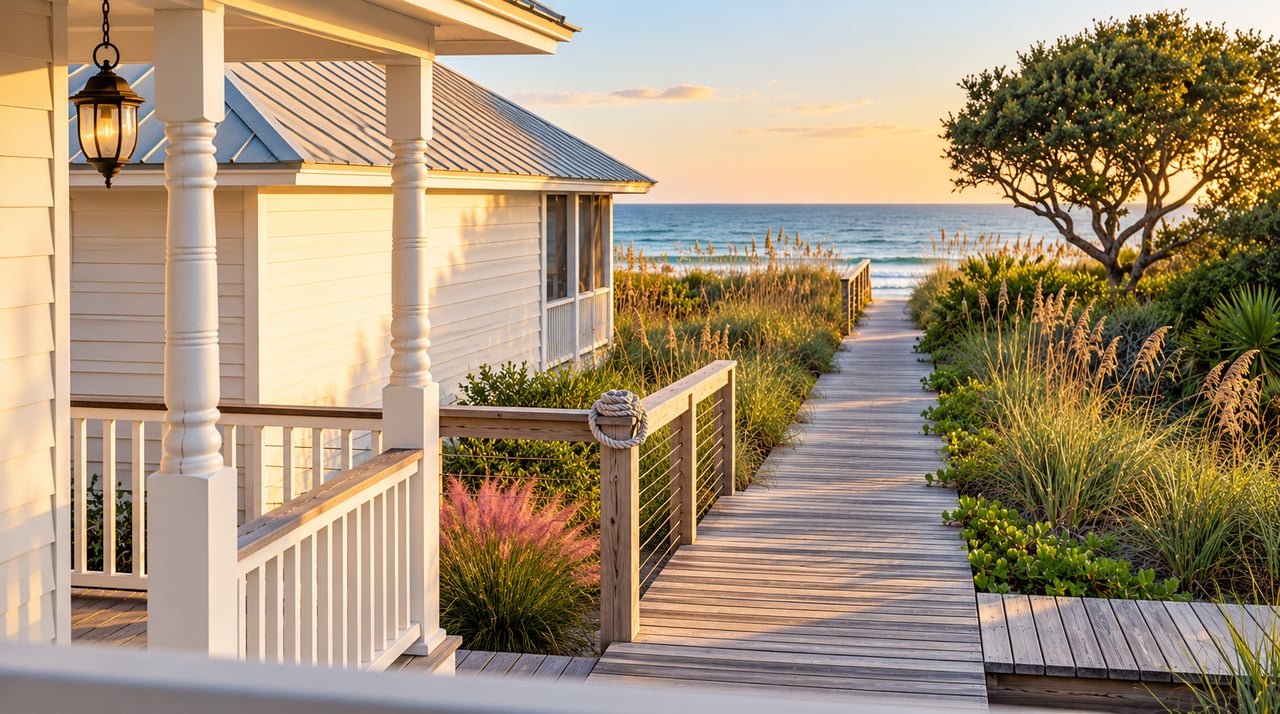
Most buyers never ask, because the question doesn't occur to them. Seaside is 80 acres. You can walk the whole town in fifteen minutes. The Gulf sits at the bottom of every street, and every cottage markets itself the same way: steps to the sand. It reads like one shared beach serving one small town. It isn't. Seaside's Gulf frontage is organized into nine separate pavilions, and which one belongs to your address is decided by the street your lot sits on, not by price, not by proximity, and not by anything a listing photo can show you.
Nine Pavilions, Nine Owners
Walk the row from east to west and you pass Tupelo, Savannah, East Ruskin, Seaside, Coleman, West Ruskin, Pensacola, Odessa, and Natchez. Each was designed by a different architect: Ernesto Buch at Tupelo, Tom Crist at Savannah, Stuart Cohen and Anders Nereim at East Ruskin, Eric Watson at the pavilion simply named Seaside, David Coleman at the obelisk-shaped Coleman Pavilion, Michael McDonough at West Ruskin, Tony Atkin at Pensacola, Roger Ferri at Odessa, and Steve Badanes and James Adamson of Jersey Devil at Natchez. Seaside's own history pages treat this as an architecture story, and it is one. It's also a property line.
With the exception of Coleman, each pavilion sits at the foot of one street and is owned by that street's homeowner association, not by the town as a whole. A cottage on Tupelo Street carries rights to the Tupelo Pavilion. A cottage two blocks away on Natchez carries rights to Natchez. There is no floating pass that lets an owner pick whichever pavilion looks best that afternoon. Coleman is the one exception, retained by the Seaside Community Development Corporation rather than a single street association, which is why it functions as the town's public-facing access point, home to the Cabana Man beach service that lets non-residents book a chair for the day. Every other pavilion is gated, coded, and reserved for the street it serves.
Nine Declarations, One Town Council
The reason access works this way traces back to how Seaside is legally structured. The town's residential streets operate under nine separate recorded declarations, each covering its own block, coordinated through a Seaside Town Council that represents the associations collectively. Town Center, the Lyceum, and the public-facing pieces of the community remain under the authority of the Seaside Community Development Corporation, the original developer entity. That split matters more than it sounds like it should, because it means there is no single governing document that tells you how beach access, rental guest rules, or parking work everywhere in town. There are nine, plus a separate set for the commercial core. The document that controls your cottage is the one recorded against your specific street, and it may say something different from the declaration two doors down.
Seaside's charm comes from its uniformity: matching picket fences, a shared design code, a single amphitheater everyone gathers around. The legal structure underneath that uniformity is not uniform at all. It is nine small associations that happen to look and act like one town.
Beach-Access Arrangements Can Change
Seaside itself has already demonstrated that these rights are not permanent fixtures. The Van Ness Butler Regional Beach Access, located between Seaside and WaterColor, used to be open to the public under a legal agreement with Walton County. That agreement is no longer in place. The land is now owned exclusively by the WaterColor Community Association, and the access point that many longtime visitors remember simply does not function the same way anymore. Nothing about that change required a new law or a public vote. An agreement expired, ownership consolidated, and the access disappeared for anyone who wasn't already inside WaterColor's declaration.
Beach access here isn't a static feature baked into the town's identity forever. It is a set of contractual rights tied to specific parcels, administered by specific associations, and subject to whatever those associations agree to next. A pavilion assignment that has worked one way for a decade is not guaranteed to work that way after the next amendment to the declaration.
The Question Worth Asking Before You Write an Offer
As of late August 2026, Seaside cottages have been trading at an average of roughly $1,393 per square foot, with homes spending an average of 115 days on the market, according to recent MLS activity in the community. That price reflects everything buyers associate with the town: the architecture, the walkability, the brand. Beach-access rights also vary by address, so confirming the details before closing is a practical part of due diligence.
Before you get attached to a floor plan, it is worth working through a short list:
- Ask which specific pavilion is deeded to this address, by street name, not by walking distance to the water.
- Request the recorded declaration for that street, not a general Seaside HOA packet, since rules on rental guest access and parking can differ block to block.
- If you plan to rent the property, confirm in writing how guest access to the pavilion is granted and whether that process has changed recently.
- Ask whether any amendments to that street's declaration are pending, since access terms can be modified by the association without a townwide announcement.
- Get an address-specific flood and windstorm insurance quote rather than relying on a neighbor's premium, since elevation and distance to the Gulf vary even within a single street.
None of this is exotic. It's the kind of paperwork request any experienced buyer's agent should already be making. The reason it matters more in Seaside than in a typical subdivision is that the town's nine-declaration structure means there isn't one standard answer. There are nine, and the only way to know which one applies to a given cottage is to ask for that street's specific document.
What This Means If You're Selling
If you own in Seaside and you're weighing a listing, the pavilion assignment is not just a compliance detail. It's a selling point, provided it's documented rather than assumed. Buyers who have done their homework will ask which pavilion serves the property and want to see the language in the declaration that confirms it. Sellers who can produce that document immediately, along with a clean special assessment history and current HOA budget, remove one of the few genuine points of friction in an otherwise straightforward transaction. In a market where homes are sitting for an average of nearly four months, anything that shortens a buyer's diligence timeline works in a seller's favor.
A Few Questions Worth Settling Early
Does every rental guest automatically get beach access in Seaside? Guests staying in a Seaside vacation rental receive access to the pavilion tied to that property's street, generally through a code or wristband provided by the rental agency managing the home. Access is tied to the address, not to Seaside as a general destination.
Can an owner use a pavilion other than the one on their street? Not as a matter of right. Each pavilion outside of Coleman is controlled by its street's association for the benefit of that street's owners and their guests.
Is there any way for the general public to reach a Seaside beach without staying there? Coleman Pavilion, at the foot of Town Center, is the one access point available to non-residents, and only through a booked chair setup with Seaside's Cabana Man service. Personal chairs, umbrellas, and full-size coolers aren't permitted in that area, and the nearest open public access outside Seaside's boundary is a short distance east.
Seaside is a cohesive town, but beach access is organized street by street through separate associations. Before buying, ask which pavilion serves the property and review the applicable declaration so you know what access is included.
If you're weighing a purchase or a listing in Seaside and want someone who can pull the right declaration for the right street before you're three showings deep, The Morar Group works this stretch of 30A daily. Text or call us to start your 30A conversation.
This article is general information, not legal, tax or financial advice. Consult a qualified professional about your situation.